 Follow
He’s been influenced by Jack Kerouac reading his prose to a jazz piano, the works of Kurt Weil and Bertolt Brecht, the silky crooning of Frank Sinatra, the twist and shouting of James Brown, Rachmaninoff and the Rolling Stones, Cole Porter and George Gershwin, Prince and punk rock, rap and blues, Mexican ballads and mariachis. “I like beautiful melodies telling you terrible things,” he’s said. “The only thing I hate is bluegrass played poorly. The only thing I hate more than that is bluegrass played well.”
He sings about love, about the hobo life, and about drinking with lyrics that are often bleak and lonely. In fact, you can’t listen to Tom Waits without feeling like drinking along with him (though he gave up booze and joined AA in 1992). Here are some lines pulled from over a dozen songs:
–“Got no time to lose/time to get down to drinking/tell the band to play the blues.”
–“You know the bartenders/They all know my name.”
–“I’ll start talking from the brim of a thimble of whiskey.”
–“I don’t have a drinking problem/’cept when I can’t get a drink.”
–“So drink your martinis and stare at the moon.”
— “Smelling like a brewery,/looking like a tramp.”
–“Warm beer and cold women, I just don’t fit in.”
— “I’ll meet you at the /bottom of a bottle of/bargain Scotch.”
–“I’ll see your Red label/and I’ll raise you one more.”
–“I drunk me a river since you tore me apart.”
— “Your shovel’s a shot glass, dig your own hole.”
–“I just can’t drink no more/’cause it don’t douse the flames.”
Except for the word “commercial,” what Smokey Robinson recently said of Bob Dylan could equally be said of Tom Waits: Tom “is unique unto himself, a one-of-a-kind kind of artist. He’s controversial and commercial and underground and all those things at the same time. [Tom] tells it like he feels it, and he’s been like that for his entire career. He’s never ever pulled any punches or tried to clean it up for the public or censored himself, and that’s the thing I love about him.”
When Waits was 7 years old his family took him to Mexico where he went swimming in the Pacific Ocean. His parents were on the shore watching him as a fog rolled in and young Tom disappeared for a while. What happened during that fog altered how Tom Waits would see the world for the rest of his life. As he did his best to keep afloat in the ocean he saw a strange old ship come into view. It wasn’t just any ship; it was a pirate ship, with a pirate’s skull and crossbones flag flapping at the top of the mast, and the ship’s sails on fire. Dead pirates hung over the rails. Young Tom looked up in awe and wonder as he reached out to touch the ship, but “it turned and it went back into the fog and disappeared.” When Tom returned to tell his parents about it, they looked at him and nodded. A pirate ship? Indeed. How interesting.
When he was 11 his father, Frank, who taught secondary-school Spanish and was an alcoholic, split the family and headed for Los Angeles. His mother, also a school teacher, took Tom and his two sisters from Pomona, where he was born, to Whittier in southern California to National City and Chula Vista near the Mexican border. Mexican border towns played a big part of Tom’s youth. His father used to take him down to Tijuana for haircuts and to see carnivals and circuses. When he was 18, he went to Tijuana and had a life-altering experience when a midget prostitute climbed up on a bar stool and sat in his lap. “It was very tender,” he recalled. “She just sat in my lap.” Midgets would appear in his future songs and on the cover of Swordfishtrombone.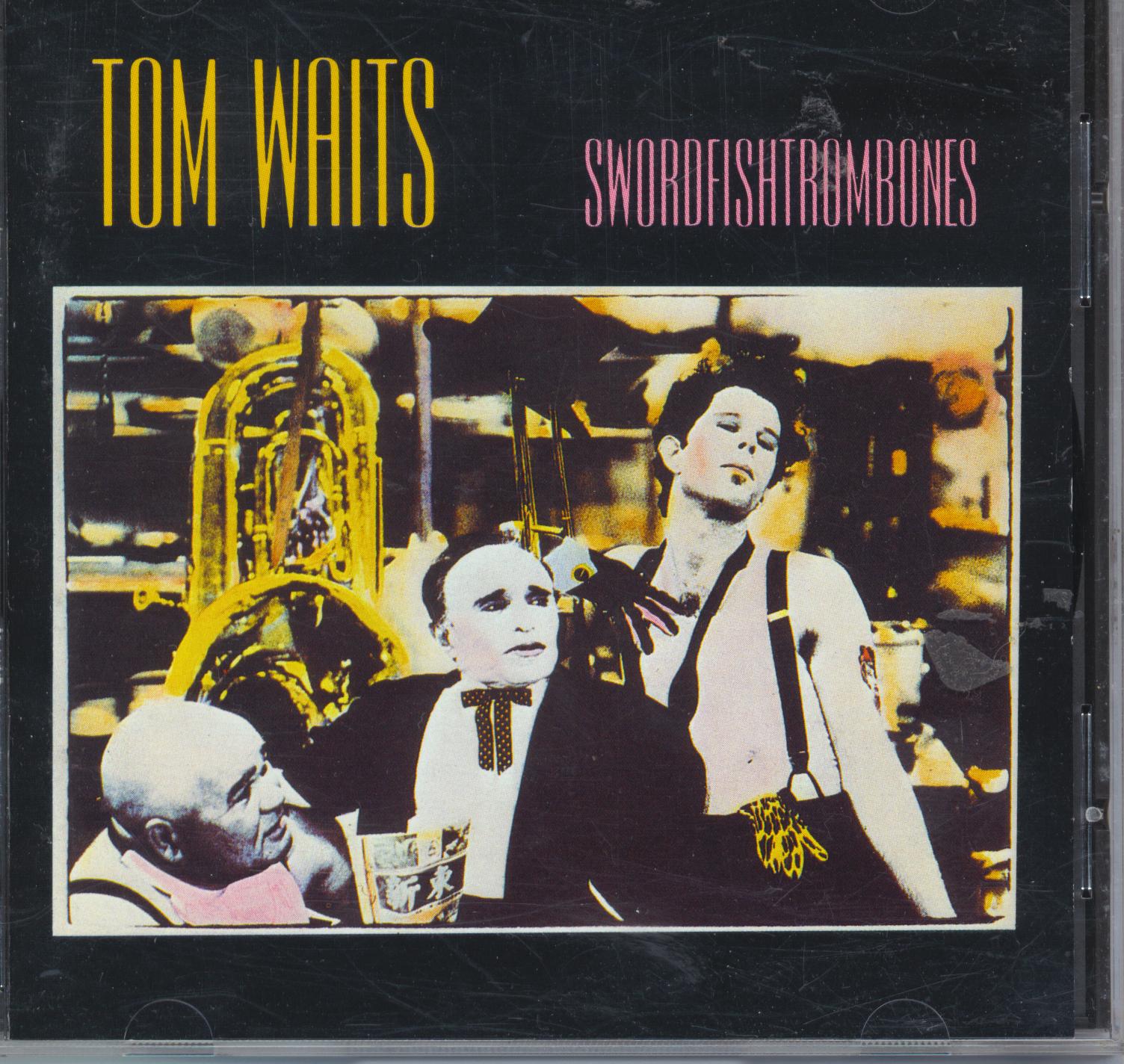
As a boy, Waits built radios and listened to Mexican mariachi music. “Music was always around when I was a kid, but there wasn’t a lot of ‘encouragement.’” Growing up in and around San Diego, he worked as a dishwasher, waiter, cook, janitor, plumber, gas station attendant, in a jewelry store, doorman at a nightclub, drove delivery trucks, cabs, and ice cream trucks. He dropped out of high school to follow his dream of being an artist. As a singer, he found encouragement at the Heritage Club in San Diego. But he knew if he wanted to make it, he would have to head to Los Angeles, which he did. For years he lived in crummy apartments and cheap hotels, where “If you get hungry at 3 a.m. you can go downstairs and the desk clerk will give you half his sandwich. They don’t do that at a Hilton.”
He looked at his formative years as “like being a traveling salesman. I’ve lived in a lot of different towns. There’s a certain gypsy quality and I’m used to it. My life is not what I would call normal or predictable.” But his gypsy lifestyle gave him material for his songs. “I like songs with the names of towns in them, with weather and something to eat. I think, ‘Oh, yeah, I can go into that world. There’s something to eat, there’s a name of a street, there’s a saloon.”

Comments are closed.